Science
Learning Leader - Mr C Devaney
Curriculum Intent
Science encompasses everything that we are and allows us to make sense of the world around us. At Weavers Academy we provide a high-quality science education designed to help develop students' curiosity and scientific knowledge. Our students will be equipped to question the world in which we live, think critically and become socially aware global citizens.
Specialist Subject leaders from across all CET secondary academies have worked together to construct a Science curriculum which is ambitious and serves the needs of the students within our schools. The Science leadership team at Weavers Academy have adapted this curriculum for our own specific context. At its core, our spiralling curriculum is knowledge-rich in nature, ensuring that students are provided with the content that they need to succeed within the subject disciplines. Alongside this, authentic diverse content had been woven into our curriculum ensuring that all students feel a sense of belonging as they enjoy their learning journey. The knowledge-rich approach to curriculum is also supported by a knowledge-rich approach to assessment. Summative end of unit assessments are supplemented by annual assessments which are all utilised to help both inform curriculum design, and, to evaluate its impact at a topic level. Like the curriculum, these assessments are designed by subject leaders at our Academy, informed by good practice shared by our sister schools.
As students’ progress through their scientific education, they should be able apply their scientific thinking and vocabulary to explain a wide range of phenomena, develop their experimental skills through a variety of scientific investigations and use their observations to justify the conclusions that they have made, whilst using their analytical and evaluative skills to critically analyse information that they are presented with.
The Weavers Academy Science Department has high expectations of all members of its community. We are committed to our Academy’s PRIDE values
In terms of productivity, the Science department is committed to fully supporting all of our students to consistently produce work above that which is usually expected with respect to individual target grades. Students are encouraged to be determined to succeed when work is challenging. Students are empowered by our embedded academy ‘climates for learning’ to work effectively both collaboratively and independently; ultimately to achieve high outcomes in external assessments which will help to provide our students with more opportunities in adult life. Our knowledge rich Science curriculum that has been tailored for our local context stimulates high levels of student engagement whilst the built-in and authentic diversity threads ensure that all students feel a sense of belonging through their curriculum journey, showing respect for themselves and others.
To achieve the expected impact, the Weavers Academy Science curriculum aims to ensure that all pupils:
- have their individual needs considered and supported, including those from disadvantaged background, and with SEND. This will result from the Science curriculum being designed with an understanding of how learners learn.
- benefit from astute sequencing of knowledge-rich concepts to lead to deep learning through the bespoke spiral curriculum.
- develop confidence and competence in order to succeed in practical science activities.
- become proficient in critical thinking.
- engage in healthy debate about a range of ethical discussions.
- develop evaluative skills to analyse data and question anomalies.
- develop resilience and confidence.
- become scientifically literate, so they understand what they see in the news and the world around them.
- experience Science cultural capital throughout the curriculum.
- understand the range of scientific careers available to them and make explicit connections between content studied and future careers.
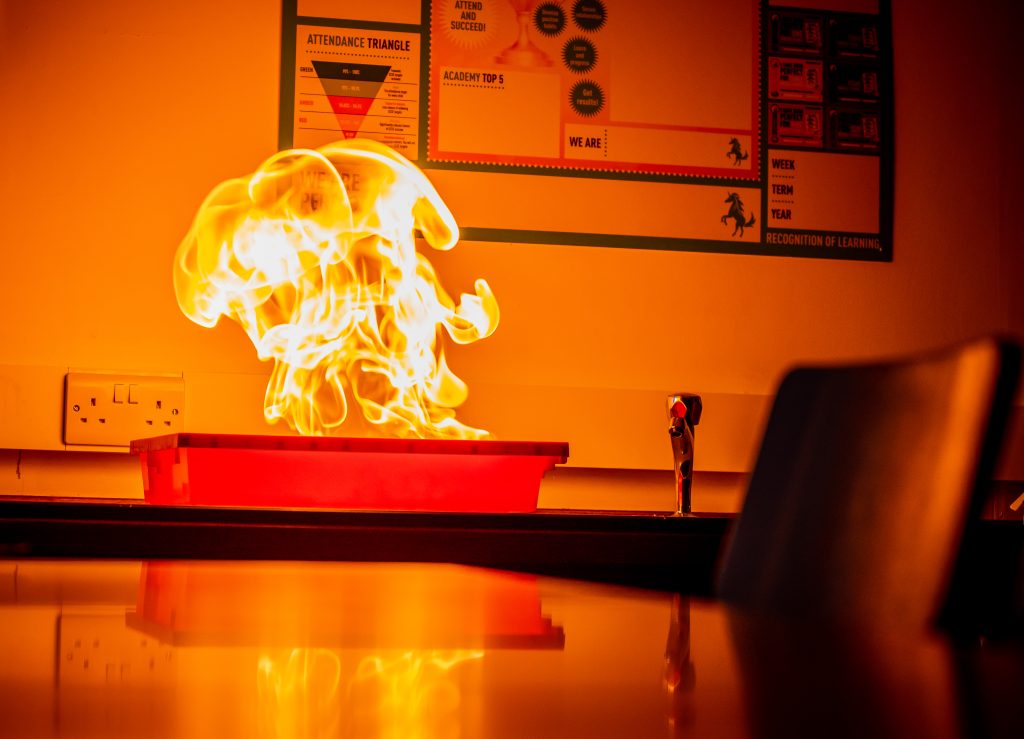
Key Stage 3:
Our Weavers Academy Science spiral curriculum is designed to review and build upon fundamental concepts first encountered by students at key stage 2. Key concepts and topics are revisited year after year with added complexity.
Key Stage 3 students are able to conduct experimental investigations, obtain valid results and use graphical techniques to analyse and interpret data. They can develop their own experimental methodologies and select and use appropriate apparatus and techniques. They will be able to relate fundamental scientific knowledge to data and evidence collected in the laboratory and understand how this is used to develop models. They will be able to apply mathematical skills to solve relatively simple scientific problems. They have developed scientific skills (the ability to analyse, communicate effectively, enquire and solve) are interleaved through multiple units of study and intertwined in the delivery of practical skills, data handling and subject knowledge.
Year 7
Year 7: By the end of the year students are aware of the purpose of the steps in scientific methodology and can conduct lab work purposefully and safely.
- In biology students have the scientific literacy to discuss ecosystems, cells and movements, digestion and gas exchange.
- In chemistry students have developed an understanding of the foundations of Chemistry, Earth Sciences and the periodic table and elements.
- In physics students can model situations involving forces and light and sound.
- Thinking like a Scientist skills (Analyse, Communicate, Enquire and Solve) run throughout all topics intertwined in the delivery of practical skills, data handling and knowledge. Students will develop their lab skills as well as an appreciation of the benefits of diversity in Science at the beginning of the year.
Year 7 Curriculum Map
| Autumn | Spring | Summer | |
|---|---|---|---|
|
Biology |
Ecosystems |
Cells and Movement |
Digestion and Gas Exchange |
|
Chemistry |
Foundations of Chemistry |
Earth Structure and Rock Cycle |
Periodic table and elements |
|
Physics |
Introduction to Physics |
Sound and Light |
Quantifying Energy |
Year 8
By the end of year 8 students can and can conduct experimental investigations and obtain valid results and use graphical techniques to analyse and interpret results.
- In biology students have the knowledge to accurately discuss genetics and evolution, reproduction in plants and animals and photosynthesis and respiration.
- In chemistry students can use conventions in chemistry to describe rocks, earth science, metals and non-metals and acids and alkalis.
- In physics students can analyse situations involving sound and light, space and electricity and electromagnetism, including the use of numeracy for calculations.
- Thinking like a Scientist skills (Analyse, Communicate, Enquire and Solve) run throughout all topics intertwined in the delivery of practical skills, data handling and knowledge. Students will understand and be critical of how science is portrayed in the media.
Year 8 Curriculum Map
| Autumn | Spring | Summer | |
|---|---|---|---|
|
Biology |
Science in the Media Genetics and Evolution |
Reproduction |
Photosynthesis and Respiration |
|
Chemistry |
Separating Mixtures |
Climate and resources |
Metals and Non-metals, acids and alkalis. |
|
Physics |
Forces and Motion |
Space |
Electricity and Electromagnetism |
Year 9
By the end of year 9 students can develop experimental methods and use accurate apparatus and techniques. They can relate fundamental knowledge to evidence collected in the lab and how that is used to develop models.
- In biology students have acquired the fundamental knowledge about microbiology and the challenges in healthcare. They have the numeracy skills for biology to apply to more complex problem solving.
- In chemistry students can use conventions in chemistry to explain what happens on an atomic level when reactions occur, the different types of reactions that occur and explain the structure and behaviour of atoms, elements, compounds and mixtures.
- In physics students can apply mathematical skills to analyse energy transfers, apply ideas about particle theory to explain changes of state, use models to explain the interaction of waves with matter, and analyse the effects of forces.
- Thinking like a Scientist skills (development of scientific thinking, experimental skills and strategies, analysis and evaluation, scientific vocabulary) run throughout all topics. Students develop Maths in Science skills to prepare them for the challenge of GCSE and beyond.
Year 9 Curriculum Map:
| Autumn | Spring | Summer | |
|---|---|---|---|
|
Biology |
Science in the Media Health Cell Biology |
Ecosystems |
Atomic Structure |
|
Chemistry |
Types of reactions. |
Chemical energy |
|
|
Physics |
Energy- heating and cooling |
Forces and their effects Wave Interactions |
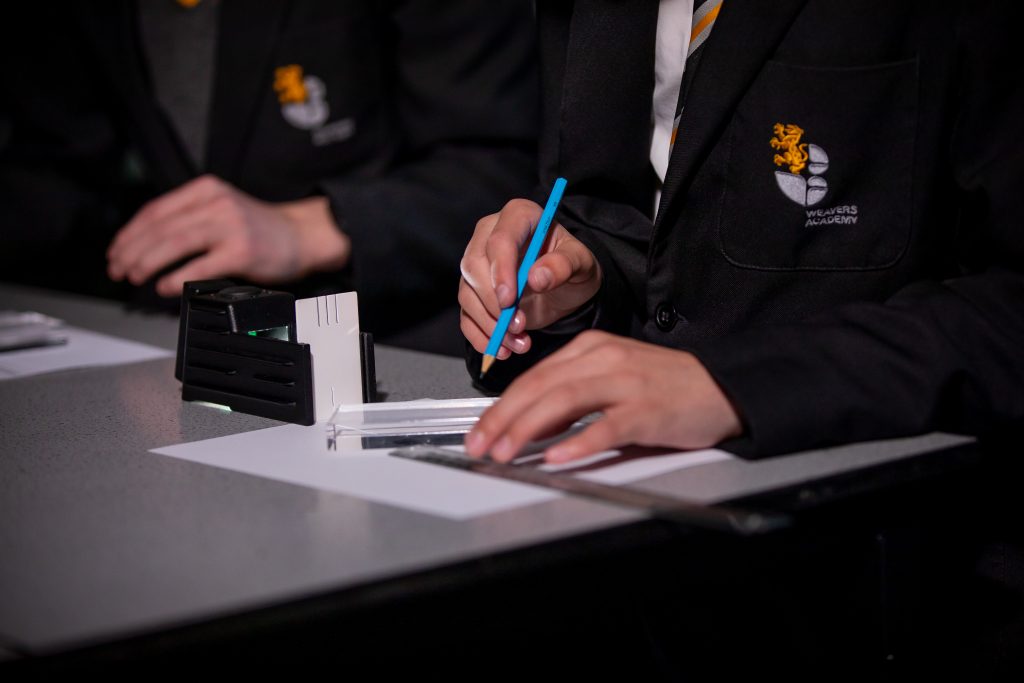
Key Stage 4:
The Science department aim to provide the opportunity for pupils to further develop their sense of excitement and curiosity about the subject/s and to develop a good understanding of the nature, processes and methods of Science through key stage 4.
The curriculum is designed to enable students to develop scientific knowledge and conceptual understanding of the disciplines of Biology, Chemistry and Physics and equip them with the scientific knowledge required to understand the uses and implications of science, today and for the future.
Our co-constructed CET curriculum outlines the sequencing of all core concepts from previous and future key stages which supports teaching and learning delivery. Students will develop competency in the learning points outlined in the AQA GCSE specifications within our curricula.
At Key Stage 4, students follow either the AQA GCSE Combined Science: Trilogy or AQA GCSE Triple Science specification.
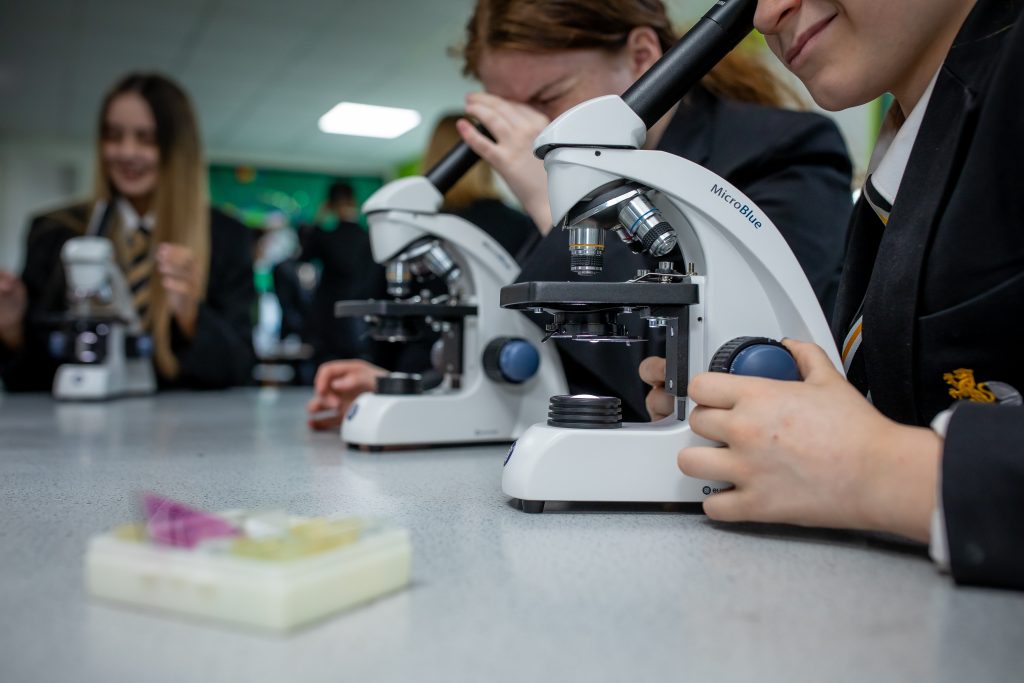
AQA GCSE Combined Science: Trilogy
Specification: https://www.aqa.org.uk/subjects/science/gcse/science-8464/specification/specification-at-a-glance
AQA Triple Science
Specifications:
Biology: https://www.aqa.org.uk/subjects/biology/gcse/biology-8461/specification/specification-at-a-glance
Physics: https://www.aqa.org.uk/subjects/physics/gcse/physics-8463/specification/specification-at-a-glance
KS4 Curriculum Map:
| Autumn | Spring | Summer | |
|---|---|---|---|
| Year 10 |
Subject Content: 5.1 Atomic Structure 6.1 Energy |
Subject Content: 5.3 Quantitative chemistry 6.3 Particle model of matter |
Subject Content: 6.5 Forces |
| Year 11 |
Subject Content: 5.7 Organic Chemistry 6.6 Waves |
Subject Content: Question level analysis of mock exams used to design and deliver targeted revision |
Exams |
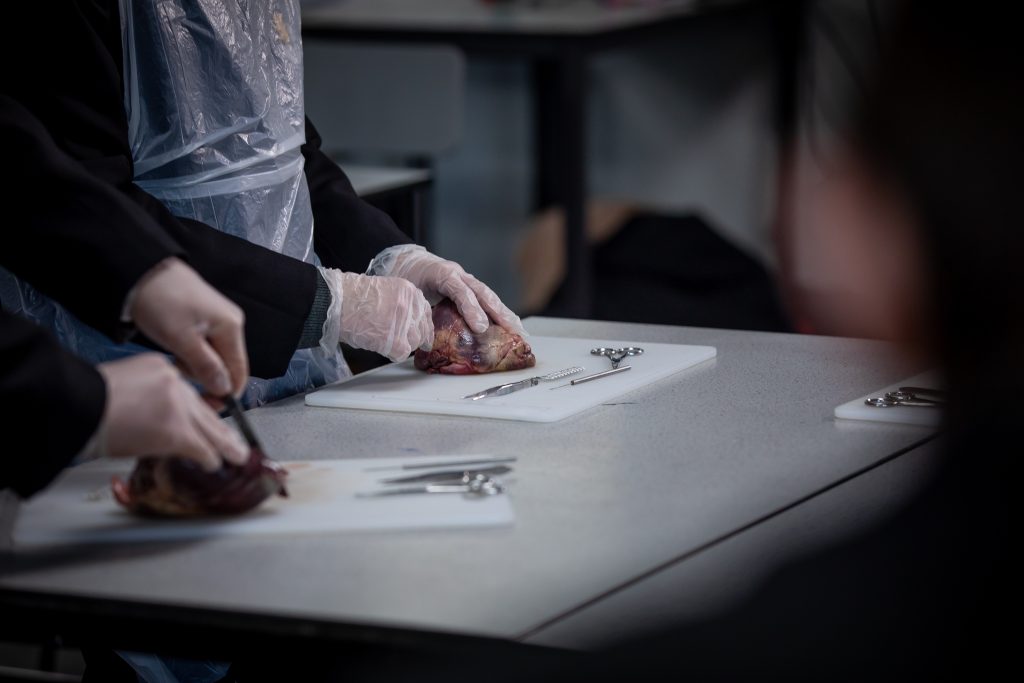
Key Stage 5:
The Science department aim to provide the opportunity for pupils to further develop their sense of excitement and curiosity about the subject/s and to develop a deep understanding of the nature, processes and methods of Science through enquiry at key stage 5.
They develop the knowledge and skills required to successfully transition to Higher Education and Science specific vocations thereafter.
Students at Weavers Academy have the opportunity to study up to four level 3 Science subjects/courses, i.e. OCR A-Level Biology A , OCR A-Level Chemistry A, OCR A-Level Physics A and WJEC Level 3 Applied Diploma in Medical Science.
OCR Biology A A-Level
Specification: https://www.aqa.org.uk/subjects/biology/a-level/biology-7402/specification/specification-at-a-glance
| Subject content: | How is OCR A-Level Biology A assessed? |
|---|---|
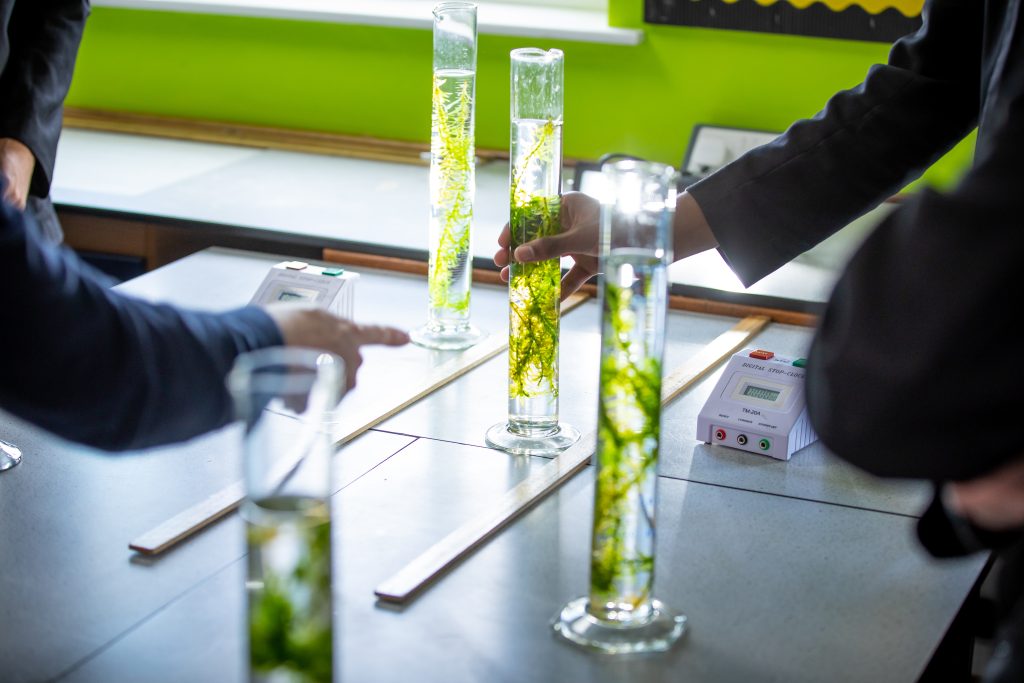
| Module 1: Development of practical skills in biology Module 2: Foundations in biology Module 3: Exchange and transport Module 4: Biodiversity, evolution and disease Module 5: Communication, homeostasis and energy Module 6: Genetics, evolution and ecosystems |
Paper 1 – Biological processes 100 marks, 2 hours 15 mins 37% of A-level Assesses content from modules 1, 2, 3 and 5 Paper 2 – Biological diversity 100 marks, 2 hours 15 mins 37% of A-Level Assesses content from modules 1, 2, 4 and 6 Paper 3 Unified biology 70 marks, 1 hour 30 mins 26% of A-Level Assesses content from all modules (1 to 6) Practical endorsement in biology Non-exam assessment |
Curriculum Map:
| Autumn | Spring | Summer | |
|---|---|---|---|
| Year 12 |
|
|
|
| Year 13 |
|
|
|
OCR Chemistry A A-Level
Specification: https://www.aqa.org.uk/subjects/chemistry/a-level/chemistry-7405/specification/specification-at-a-glance
| Subject content: | How is OCR Chemistry A A-Level assessed? |
|---|---|
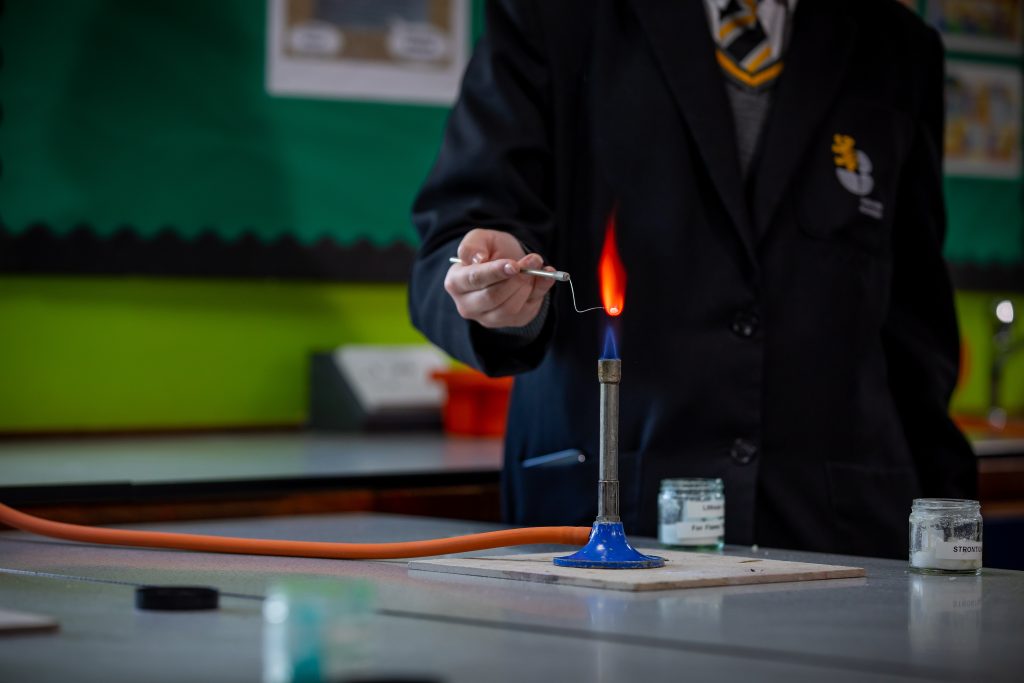
| Module 1 – Development of practical skills in chemistry Module 2 – Foundations in chemistry Module 3 – Periodic table and energy Module 4 – Core organic chemistry Module 5 – Physical chemistry and transition elements Module 6 – Organic chemistry and analysis |
Paper 1 – Periodic table, elements and physical chemistry 100 marks, 2 hour 15 mins 37% of A-Level Assesses content from modules 1, 2, 3 and 5 Paper 2 – Synthesis and analytical techniques 100 marks, 2 hour 15 mins 37% of A-Level Assesses content from modules 1, 2, 4 and 6 Paper 3 – Unified chemistry 70 marks, 1 hour 30 minute 26% of A-Level Assesses content from all modules (1 to 6) Practical endorsement in chemistry Non-exam assessment |
Curriculum Map:
| Autumn | Spring | Summer | |
|---|---|---|---|
| Year 12 |
|
|
3.3.6 Organic Analysis 3.2.5 Transition Elements 3.3.15 NMR 3.3.16 Chromatography Revision
|
| Year 13 |
|
|
3.3.15 NMR 3.3.16 Chromatography Revision
|
OCR Physics A A-Level
Specification: https://www.aqa.org.uk/subjects/physics/a-level/physics-7408/specification/specification-at-a-glance
| Subject content: | How is OCR Physics A A-Level assessed? |
|---|---|
| Module 1: Development of practical skills in physics Module 2: Foundations in physics Module 3: Forces and motion Module 4: Electrons, waves and photons Module 5: Newtonian world and astrophysics Module 6: Particles and medical physics |
Paper 1 – Modelling physics 100 marks, 2 hours 15 mins 37% of A-Level Assesses content from modules 1, 2, 3 and 5 Paper 2 – Exploring physics 100 marks, 2 hours 15 mins 37% of A-Level Assesses content from modules 1, 2, 4 and 6 Paper 3 – Unified physics 70 marks, 1 hour 30 mins 26% of A-Level Assesses content from all modules (1 to 6) Practical endorsement in physics Non-exam assessment |
Curriculum Map:
| Autumn | Spring | Summer | |
|---|---|---|---|
| Year 12 |
|
|
|
| Year 13 |
|
|
|
WJEC Level 3 Applied Diploma in Medical Science
| Subject content: | How is this assessed? |
|---|---|
| Unit 1: Human health and disease Unit 2: Physiological measurement techniques Unit 3: Medical Science research methods Unit 4: Medicines and treatment of disease Unit 5: Clinical laboratory techniques Unit 6: Medical case study |
25%, external 12.5%, internal 12.5%, internal 25%, internal 12.5%, external 12.5%, external |
Curriculum Map:
| Autumn | Spring | Summer | |
|---|---|---|---|
| Year 12 |
|
|
|
| Year 13 |
|
|
|