History
Subject lead: Mr Simpson
Curriculum Intent
History matters because it helps us understand how societies, ideas, and events have shaped the world we live in today. By studying the past, we learn about cause and consequence, change and continuity, and the significance of key individuals and movements. History develops critical thinking, analytical skills, and the ability to evaluate evidence and interpretations. It teaches us to question narratives, challenge assumptions, and make informed judgments. Most importantly, history provides context for present-day issues, helping us avoid repeating mistakes and preparing us to be thoughtful, responsible citizens who can engage with complex global challenges.
“The Weavers History Department aims to inspire curiosity, critical thinking, and provide young minds with the tools to fully understand the past in order to shape the future.
We strive to create an inclusive environment where students develop analytical skills, explore diverse perspectives, and reflect on history to become thoughtful, responsible members of society, who, when unleashed into the world, can and will change it for the better.”
Specialist subject leaders across CET secondary academies have collaborated to design a History curriculum that is ambitious, coherent, and responsive to the needs of our students. At Weavers Academy, our History leadership team has adapted this framework to reflect our local context while maintaining high academic expectations. At its heart, our curriculum is knowledge-rich and concept-driven, ensuring students acquire the essential content and disciplinary thinking required for success at A Level and beyond.
Our curriculum is built around second-order concepts that underpin historical scholarship:
-
Cause and Consequence – understanding why events happened and their short- and long-term impact.
-
Change and Continuity – identifying patterns of stability and transformation across time.
-
Significance – evaluating the importance of individuals, events, and ideas in shaping history.
-
Evidence – interrogating primary sources to construct well-supported arguments.
-
Interpretation – analysing how and why historians disagree and how views of the past are constructed.
This conceptual approach is embedded within a spiralling structure, revisiting themes and skills at increasing levels of complexity. Alongside this, authentic and diverse perspectives are woven throughout, ensuring all students see themselves reflected in the historical narrative and feel a sense of belonging.
Assessment mirrors this knowledge-rich philosophy. End-of-unit and annual assessments are designed to test both substantive knowledge and disciplinary skills, informing curriculum refinement and evaluating impact. These assessments are created by our academy’s subject leaders, drawing on best practice across CET schools.
As students progress through their historical education, they will:
-
Apply historical vocabulary and conceptual frameworks to explain significant developments.
-
Analyse sources and interpretations critically, using evidence to justify conclusions.
-
Construct well-reasoned, balanced arguments in extended writing.
-
Make connections across periods, identifying patterns of continuity and change.
-
Evaluate significance and causation to understand the complexity of historical processes.
Ultimately, our curriculum equips students not only to succeed academically but also to think historically, developing analytical, evaluative, and critical skills that enable them to engage thoughtfully with the past and its relevance to contemporary society.
The Weavers Academy History Department has high expectations of all members of its community and is committed to our Academy’s PRIDE values:
We uphold PRIDE values in History: Productivity through high-quality work using retrieval, analysis, and second-order concepts; Respect by embedding diverse perspectives and tackling sensitive issues thoughtfully; Independence via research and interpretation skills; Determination when addressing complex narratives and contested views; and Engagement through interactive lessons, debates, and enrichment. Our curriculum fosters curiosity, resilience, and critical thinking, preparing students to succeed academically and understand the past’s relevance to today.
Expected Impact
The Weavers Academy History curriculum ensures all pupils receive inclusive, adaptive teaching and access a carefully sequenced, knowledge-rich programme that deepens understanding of substantive content and second-order concepts. Students build confidence in analysis, interpretation, and extended writing, engage in debate, and develop resilience and independence. They become historically literate, experience cultural capital through diverse histories and enrichment, and explore career pathways, connecting historical skills to future opportunities.
Key Stage 3:
Our Key Stage 3 History curriculum is designed to spark curiosity and enthusiasm for the subject while laying strong foundations for future study. We aim to help students understand that history is both contested and constructed, encouraging critical thinking about the past and its relevance today. Through carefully selected content, students learn about significant events, individuals, and turning points that shaped Britain and the wider world. This contextual understanding enables them to explore present-day issues such as racism, sexism, anti-Semitism, homophobia, and other forms of discrimination. By teaching the historical roots of these challenges, we empower students to become informed, responsible citizens who avoid repeating past mistakes.
Year 7 Curriculum Map:
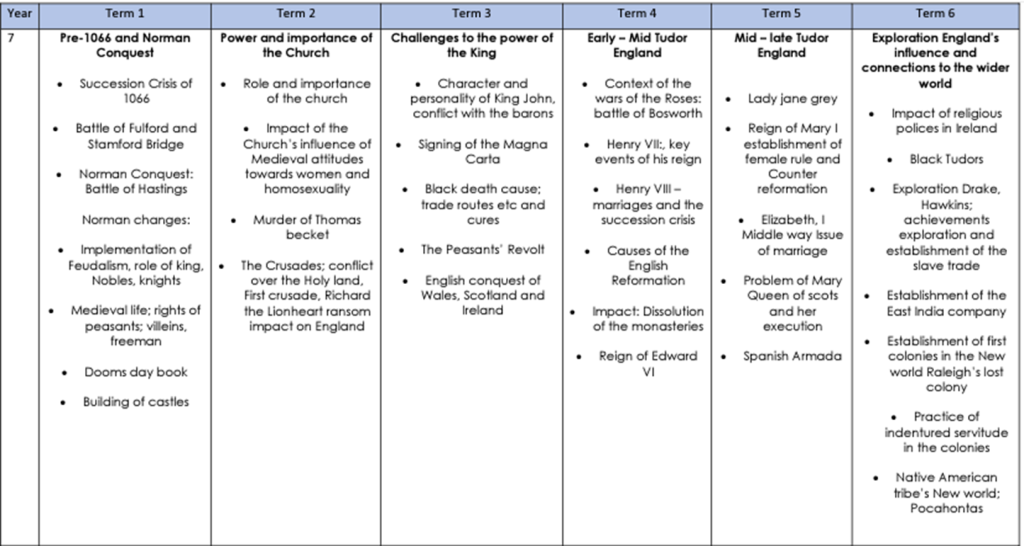
Year 8 Curriculum Map:
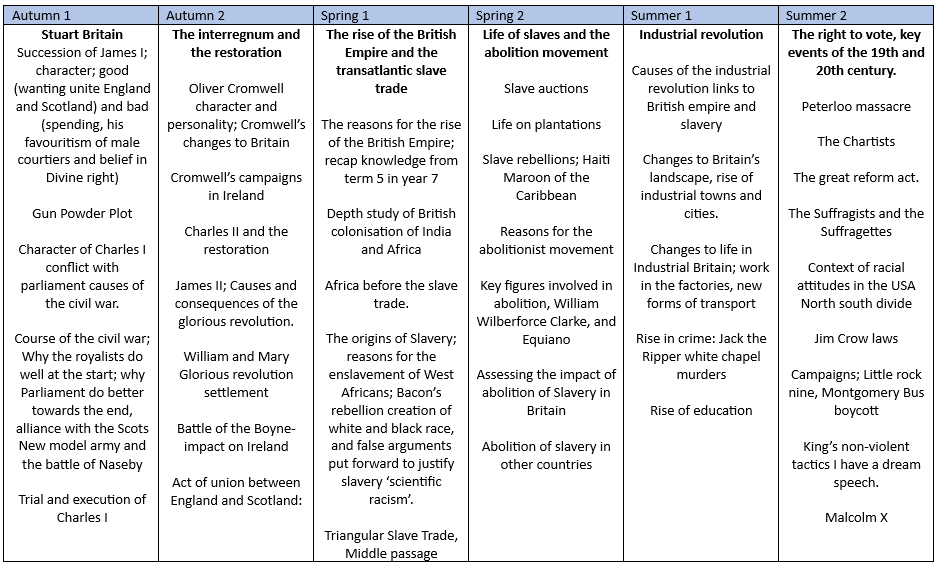
Year 9 Curriculum Map:
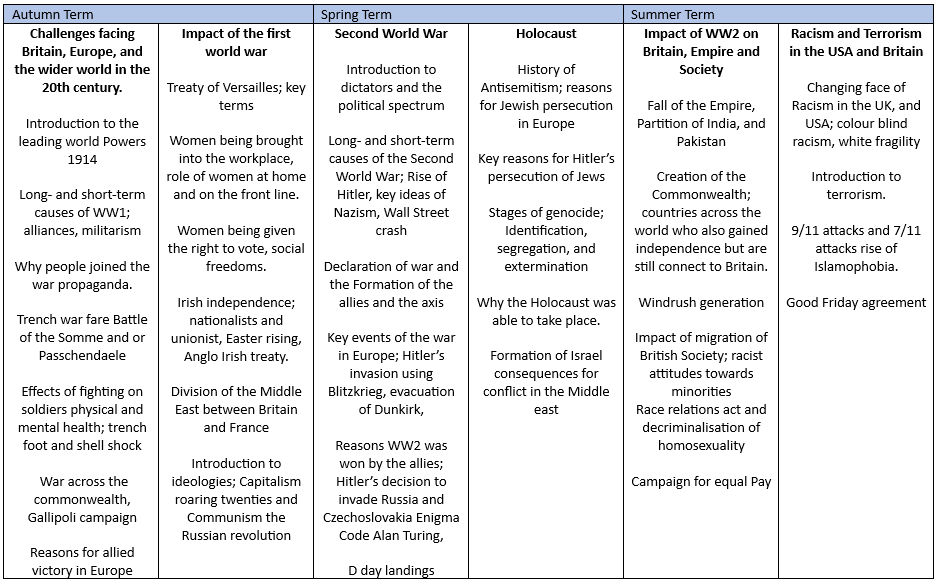
Key Stage 4:
Our Key Stage 4 History curriculum builds on prior learning to deepen students’ understanding of history as a contested and constructed discipline. It aims to foster curiosity, critical thinking, and enthusiasm while equipping students with the knowledge and skills needed for success at GCSE and beyond. Through four carefully selected depth studies—Thematic (Medicine Through Time), British (Norman England), Period (Weimar and Nazi Germany), and World (American West)—students explore significant events, individuals, and ideas that shaped societies. These studies also provide insight into contemporary issues such as health, prejudice, political ideologies, and global conflict, helping students understand the roots of challenges like anti-Semitism, inequality, genocide and the impact of democracy and dictatorship.
Curriculum Map:


Key Stage 5:
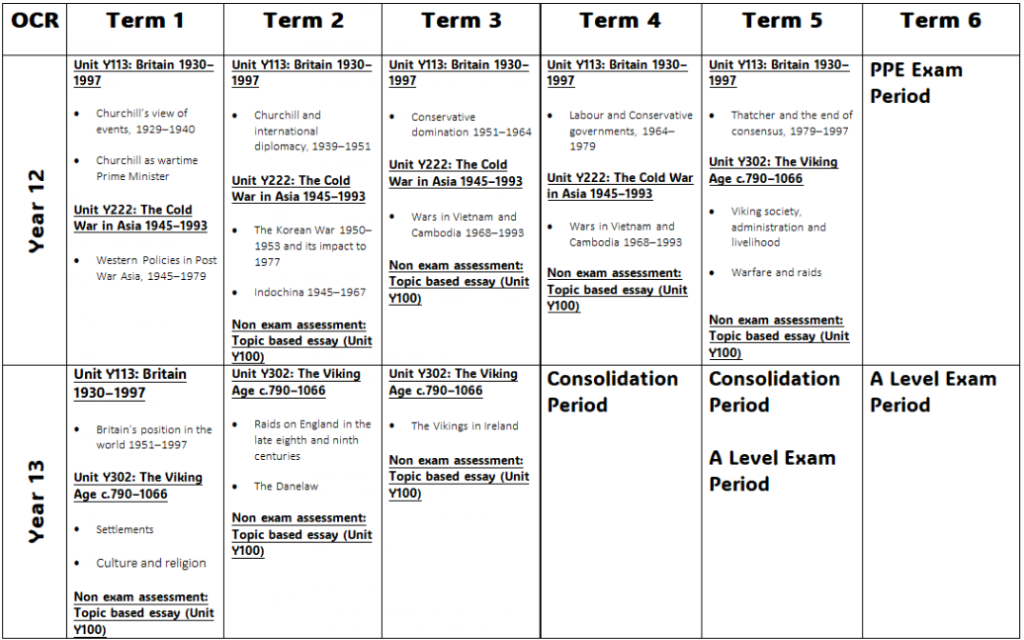
Our Key Stage 5 History curriculum is designed to challenge and inspire students through rigorous academic study, fostering intellectual curiosity and critical thinking. At A Level, students engage with complex historical debates and interpretations, developing a nuanced understanding of how the past is constructed and contested. The curriculum offers both breadth and depth through three substantial units and an independent investigation.
Students study Britain 1930–1997, examining political, economic, and social change; the Cold War in Asia, exploring superpower rivalry and intervention in Korea, Vietnam, and Cambodia; and the Viking Age, investigating Scandinavian society and cultural transformation. Alongside these units, they complete an NEA research project, developing advanced skills in evidence analysis, interpretation, and academic writing for higher-level study.
Our intent is to equip students with the knowledge and skills to succeed in higher education and beyond, while enabling them to understand historical contexts that shape contemporary issues such as democracy, ideology, and cultural identity.
Curriculum Map:
Student Leadership
We regularly promote students leadership through in class debates and also through student voice where our subject ambassadors feedback to us on the quality of their learning and how we can further develop and enrich their learning experience.