Art
Subject lead: Miss Berry
Curriculum Intent
The Art Curriculum has been specifically designed to develop and strengthen students’ creativity, visual literacy, problem-solving skills, and cultural and contextual understanding of the world around them. The content is carefully selected to underpin these areas and challenge all students at all levels, at all times.
Art and Design offers opportunities for students to explore their creativity, imagination, and problem-solving skills through visual, tactile, and the formal elements. Students experiment with a wide range of media in response to the disciplines of Art, developing practical, technical, and critical skills while communicating ideas, feelings, and meanings inspired by the work of artists and designers.
Art is a key subject in providing character education, supporting students’ wider personal development. Our intent is underpinned by the PRIDE values which students demonstrate by working with productivity and purpose to apply artistic techniques and create high-quality outcomes. They show respect by valuing the ideas and work of others, appreciating cultural influences in art, and considering ethical and sustainable practices. Independence is encouraged as students take ownership of their creative journey, making informed decisions and developing personal responses to artistic challenges. Through determination, learners display resilience and perseverance, overcoming obstacles, refining their ideas, and striving for excellence. Engagement is evident as students actively participate in creative exploration, showing curiosity and enthusiasm for developing both practical and theoretical knowledge.
Through this approach, Art and Design equips students with the skills, knowledge, and character to interpret and respond to the world around them, preparing them for future study and life beyond school.
Key Stage 3:
Year 7 introduces the formal elements in Art. The development of the formal elements builds understanding through practical application and cultural and contextual connections.
Year 8 embeds the formal elements through experimental techniques and application, and deeper approaches to design development and refinement. Learning points are tailored to enable individual responses and more autonomy with work. Critical and analytical skills are developed through critique and evaluative work in order to strengthen the formal understanding of the Art elements.
Year 9 consolidates the formal elements and are extended through an independently led project. Drawing, experimentation, contextual learning, development and refinement and the realisation of a final piece enable students to extrapolate the knowledge and skills learnt and developed in years 7 and 8.
Key Stage 4:
The specification for our KS4 courses can be found here: https://www.ocr.org.uk/qualifications/gcse/art-and-design-j170-j176-from-2016/
Art
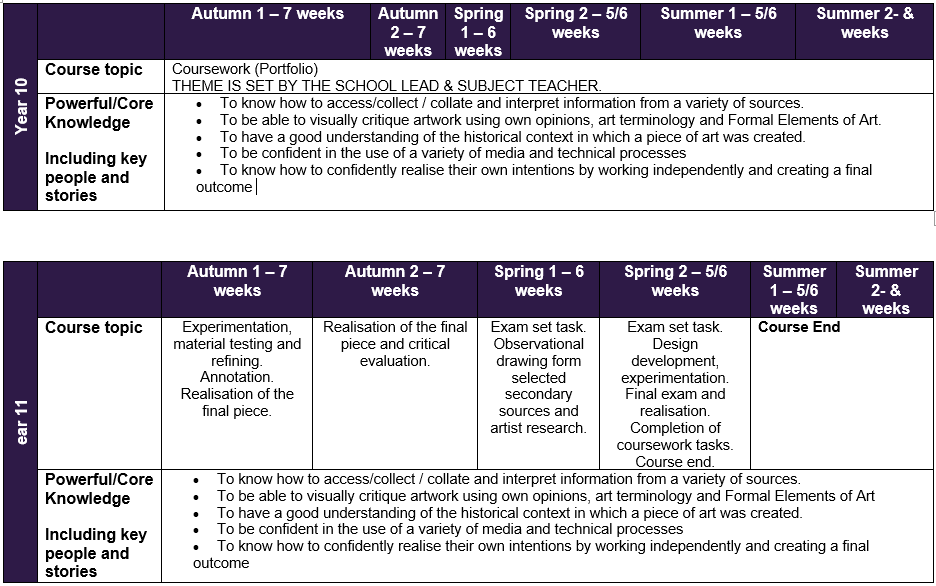
In Year 10 students will put into practice all the skills that they have acquired through a large coursework portfolio that extends, challenges and enables mastery of the year 9 format in an autonomous way. Students will critique and critically analyse their work in order to independently further the practice with sophistication and refinement.
In Year 11 students will demonstrate mastery through a selected theme in the exam paper and produce an independent study that demonstrates their knowledge and skills.
On this course, students are required to complete:
- Component 1 60% Portfolio
- Component 2 40% Externally Set Assignment.
Both components students will be able to demonstrate:
- AO1) Approaches to the development and resourcing of ideas. Using contextual materials. Analytical and cultural understanding.
- AO2) Develop knowledge of media, materials, techniques and processes. Experimentation with media and techniques. Develop skills to review and refine ideas using materials and processes.
- AO3) Record ideas, observations and insights.
- AO4) Present a personal response that is informed and meaningful.
Curriculum Map:

Photography
In year 10 Photography builds on the knowledge and skills students have studied in Art, Photography, Textiles and media.
Students will put into practice all the skills that they have acquired through a large coursework portfolio that extends, challenges and enables mastery of the year 9 format in an autonomous way.
Students will critique and critically analyse their work in order to independently further the practice with sophistication and refinement.
Students will explore skills and understanding through a range of photographic media developing awareness of both historical and contemporary photographers relating to traditional and digital photography.
Students will research and experiment with photographic techniques and technologies. This includes both traditional and contemporary processes in response to their local environment documenting their experience, experimental imagery and studio photography.
In Year 11 students will demonstrate mastery through a selected theme in the exam paper and produce an independent study that demonstrates their knowledge and skills.
On this course, students are required to complete:
- Component 1 60% Portfolio
- Component 2 40% Externally Set Assignment.
Both components students will be able to demonstrate:
- AO1) Approaches to the development and resourcing of ideas. Using contextual materials. Analytical and cultural understanding.
- AO2) Develop knowledge of media, materials, techniques and processes. Experimentation with media and techniques. Develop skills to review and refine ideas using materials and processes.
- AO3) Record ideas, observations and insights.
- AO4) Present a personal response that is informed and meaningful.
Curriculum Map:

Textiles
In Year 10 students will put into practice all the skills that they have acquired through a large coursework portfolio that extends, challenges and enables mastery of the year 9 format in an autonomous way. Students will critique and critically analyse their work in order to independently further the practice with sophistication and refinement.
Students will explore, acquire and develop skills, knowledge and understanding through the application of techniques and processes specific to the study of Textile Design.
Exploration of practical and relevant critical and contextual sources such as the work of historical and contemporary textile designers and the different purposes, intentions and functions of textile design will inspire and develop students own work. This is in connection to constructed and digital textiles, Fashion design, Stitched and embellished textiles. Students will work creativity with processes and techniques including weaving, surface printing, pattern making, pattern cutting, embroidery both machine and hand, batik, appliqué and collage.
In Year 11 students will demonstrate mastery through a selected theme in the exam paper and produce an independent study that demonstrates their knowledge and skills.
On this course, students are required to complete:
- Component 1 60% Portfolio
- Component 2 40% Externally Set Assignment.
Both components students will be able to demonstrate:
- AO1) Approaches to the development and resourcing of ideas. Using contextual materials. Analytical and cultural understanding.
- AO2) Develop knowledge of media, materials, techniques and processes. Experimentation with media and techniques. Develop skills to review and refine ideas using materials and processes.
- AO3) Record ideas, observations and insights.
- AO4) Present a personal response that is informed and meaningful.
Curriculum Map:
Key Stage 5:
The specification for our KS5 courses can be found here: https://www.ocr.org.uk/qualifications/as-and-a-level/art-and-design-h200-h600-from-2015/
Art
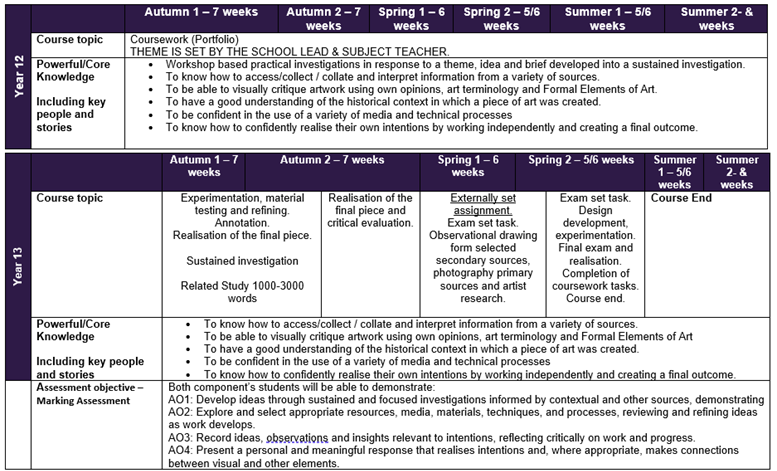
Students explore and experience a broad range of traditional and new media, processes and techniques appropriate to the chosen area of study in the field of art. Responses to this will be shown through practical and critical activities which demonstrate the students’ understanding of different styles, genres and traditions.
This qualification supports the exciting creative pathway to progress to higher education or employment.
On this course, students are required to complete:
- Component 1 60% Personal investigation. This is a practical investigation supported by written material.
- Component 2 40% Externally Set Assignment.
Both components students will be able to demonstrate:
- AO1: Develop ideas through sustained and focused investigations informed by contextual and other sources, demonstrating analytical and critical understanding.
- AO2: Explore and select appropriate resources, media, materials, techniques and processes, reviewing and refining ideas as work develops.
- AO3: Record ideas, observations and insights relevant to intentions, reflecting critically on work and progress.
- AO4: Present a personal and meaningful response that realises intentions and, where appropriate, makes connections between visual and other elements.
Curriculum Map:

Photography
Students explore and experience a broad range of traditional and new media, processes and techniques appropriate to the chosen area of study in the field of photography. Responses to this will be shown through practical and critical activities which demonstrate the students’ understanding of different styles, genres and traditions.
Students will develop areas of study including Portraiture, Moving image, Animation, Still life photography, Commercial photography and Landscape photography embedding the formal elements of Photography.
Throughout this programme students gain experience and opportunities with other practitioners and universities, entering competitions and exhibitions
This qualification supports the exciting creative pathway to progress to higher education or employment.
On this course, students are required to complete:
- Component 1 60% Personal investigation. This is a practical investigation supported by written material.
- Component 2 40% Externally Set Assignment.
Both components students will be able to demonstrate:
- AO1: Develop ideas through sustained and focused investigations informed by contextual and other sources, demonstrating analytical and critical understanding.
- AO2: Explore and select appropriate resources, media, materials, techniques and processes, reviewing and refining ideas as work develops.
- AO3: Record ideas, observations and insights relevant to intentions, reflecting critically on work and progress.
- AO4: Present a personal and meaningful response that realises intentions and, where appropriate, makes connections between visual and other elements.
Curriculum Map:

Textiles
Students will develop their creativity and skills through a variety of practical activities that explores a range of textile media, processes and techniques. Students will examine both traditional and contemporary media as well as investigating artists and designers in response to their practical work.
Areas of study include Fashion textiles, Costume design, Digital design, Printed and dyed materials, Constructed textiles, Interior design.
This qualification supports the exciting creative pathway to progress to higher education or employment where previous students have continued their studies in theatre design, Contour fashion, interior design.
On this course, students are required to complete:
- Component 1 60% Personal investigation. This is a practical investigation supported by written material.
- Component 2 40% Externally Set Assignment.
Both components students will be able to demonstrate:
- AO1: Develop ideas through sustained and focused investigations informed by contextual and other sources, demonstrating analytical and critical understanding.
- AO2: Explore and select appropriate resources, media, materials, techniques and processes, reviewing and refining ideas as work develops.
- AO3: Record ideas, observations and insights relevant to intentions, reflecting critically on work and progress.
- AO4: Present a personal and meaningful response that realises intentions and, where appropriate, makes connections between visual and other elements.
Curriculum Map:
Art Student Leadership:
There are exciting opportunities for students to participate in.
- These include KS3 Art club, KS4 Art club, Photography KS4 club, competitions and exhibitions.
- External opportunities include both internal and external competitions and exhibitions.