Food, Hospitality and Catering
Subject lead: Ms Ennever
Curriculum Intent
Food, hospitality and catering connect our health, culture and economy. At Weavers Academy we provide a high-quality food education that develops students’ curiosity and practical expertise, equipping them to question the world of food, make informed choices, and become socially aware global citizens who can thrive in the hospitality and food industries.
Specialist subject leaders across our Trust have collaborated to construct an ambitious Food curriculum which serves the needs of our students. Our leadership team has adapted this curriculum for our local context. At its core, our spiralling curriculum is knowledge‑rich, ensuring that students are provided with the powerful knowledge they need to succeed. Authentic and diverse content is woven throughout so that all students feel a sense of belonging as they enjoy their learning journey. Assessment mirrors this approach: end‑of‑unit summative assessments are supplemented by annual assessments and practical skill reviews which inform curriculum design and evaluate impact at topic level.
As students progress, they apply culinary and scientific thinking and vocabulary to explain food processes and industry practice; they develop practical expertise through a wide range of investigations and service simulations; they justify conclusions with observation and evidence; and they use analytical and evaluative skills to critique information, menus and products.
The Weavers Academy Food Department has high expectations of all members of its community. We are committed to our Academy’s PRIDE values:

In terms of productivity, we support all students to consistently produce work above that expected for their individual targets: precise mise en place, efficient workflow, plated outcomes to standard, and professional documentation (time plans, HACCP‑style records, evaluations). Students show respect for themselves and others by working safely and hygienically, valuing diverse cultures and cuisines, and meeting dietary, allergen and religious needs. Students work both collaboratively and independently through recipe adaptation, menu development, nutritional analysis and costing, students become increasingly autonomous and reflective practitioners. Students are driven to be determinedwhen challenges arise—balancing service timings, multi‑component dishes and iterative product development—using feedback to improve. Our knowledge‑rich curriculum, enriched by employer encounters and real briefs, maintains high engagement so that every learner sees the relevance of food education.
To achieve the expected impact, the Weavers Academy Hospitality & Catering curriculum ensures that all pupils:
• have their individual needs considered and supported, including disadvantaged pupils and those with SEND, with teaching designed around principles of how learners learn;
• benefit from astute sequencing of knowledge‑rich concepts leading to deep learning through a bespoke spiral curriculum;
• develop confidence and competence in practical food preparation, service, hygiene and food safety (including allergen management);
• become proficient in critical thinking and problem solving through design, planning and evaluation;
• engage in healthy debate about ethical and sustainability issues affecting food systems;
• develop analytical skills to interpret nutritional data, costing and customer feedback;
• build resilience and confidence through increasingly complex practicals and live briefs;
• become food‑literate—able to interpret the Eatwell Guide and national dietary guidance, food labelling and claims;
• experience cultural capital through encounters with chefs, hospitality venues, food producers and events;
• understand the range of food and hospitality careers and make explicit connections between curriculum content and future pathways.
Implementation
Our curriculum builds from fundamentals at KS3 (healthy eating, safety, commodity science and core techniques) to applied industry learning at KS4 (WJEC/Eduqas Level 1/2 Hospitality & Catering) and advanced investigation at KS5 (WJEC Level 3 Food Science & Nutrition). Schemes of learning interleave theory and practice, with explicit vocabulary instruction and retrieval routines. Practical learning is structured around progressive skill ladders and professional habits, including mise en place, safe systems of work and reflective evaluation.
Assessment
We use a knowledge‑rich approach to assessment: low‑stakes retrieval, end‑of‑unit tests and comparative practicals track conceptual understanding and technical skills. KS4 and KS5 assessments align to awarding body specifications (examined and non‑examined components). Feedback emphasises precision, consistency and professional standards, and informs curriculum refinements.
Key Stage 3:
Our spiral curriculum reviews and builds on Key Stage 2 foundations. Key concepts and techniques are revisited each year with added complexity. KS3 develops: the Eatwell model and nutrition across life stages; food provenance and sustainability; food safety and allergens; commodity science (e.g. cereals, dairy, fruit & vegetables, meat/fish/plant proteins); functional properties and methods of cookery; and core practical techniques (knife skills, sauces, pastry, doughs, batters). Students apply maths (portioning, scaling, costing) and science (heat transfer, Maillard reaction, gelatinisation, coagulation) to solve realistic problems.
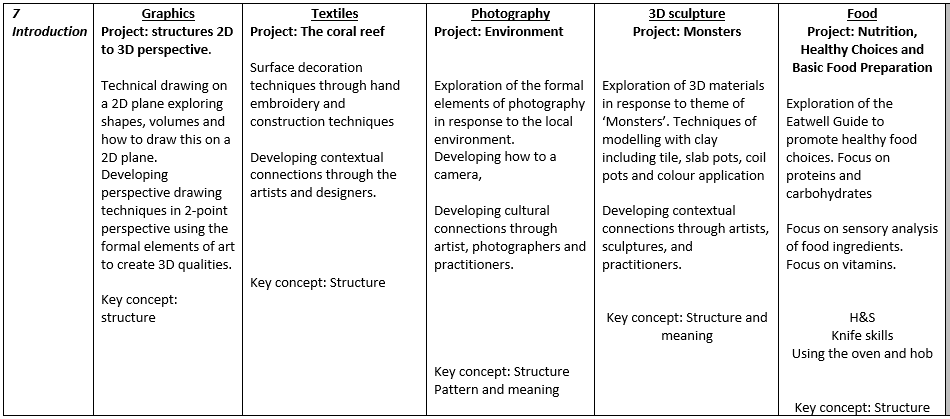
Year 7: By the end of the year 7 students will know and understand Food Safety, knife skills, the Importance of the Eatwell Guide, Basic food preparation techniques including the use of the hob and oven. Students are introduced to a range of ingredients and cooking methods through following set instructions and recipes. They are also introduced to nutrition and healthy eating.
Year 8: By the end of the year 8 students will develop their knowledge and understanding of food preparation techniques, be able to prepare family meals and develop a knowledge of food science. Students will experience using a wide range of ingredients, cooking methods and recipes following set instructions is further developed as is their understanding of nutrition and healthy eating.
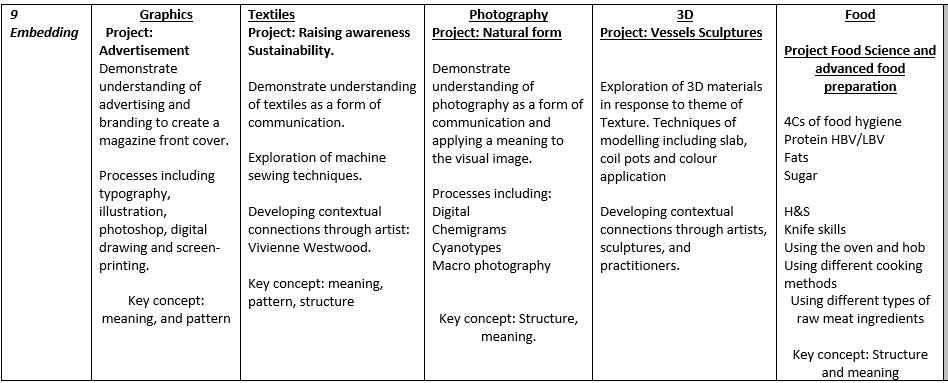
Year 9: By the end of the year 9 students will apply knowledge and understanding of advanced practical techniques to produce more complex products. This is underpinned by Food Safety, Health and Safety, Food and Nutrition and Food Choice. Students will experience using a wide range of ingredients, cooking methods and recipes following set instructions is further developed as is their understanding of nutrition and healthy eating.
The key stage 3 food curriculum is taught within the design rotation and therefore follows the same curriculum maps:
Year 7
Curriculum Map:
Year 8
Curriculum Map:

Year 9
Curriculum Map:
Key Stage 4:
At Key Stage 4, students deepen their understanding of the hospitality and catering sector and apply their learning through real‑world briefs. The WJEC/Eduqas Level 1/2 Vocational Award develops knowledge of providers, operations, roles, working conditions and success factors, alongside health, safety and food safety. Learners plan nutritious menus, respond to briefs, and prepare, cook and present dishes to professional standards before evaluating outcomes. Assessment: Unit 1 written examination (1 hour 20 minutes, 40%); Unit 2 controlled assessment (approximately 12 hours, 60%).
At key stage 4 students follow the WJEC Level 1/2 Vocational Award in Hospitality and Catering
This course equips students with the knowledge, understanding and vocational skills they need to plan, prepare, cook, and present food. The course allows students to utilise a problem-solving approach, developing solutions in relation to real time briefs using flair and creativity. The course also allows the students to develop a sound knowledge of the Hospitality and Catering Industry and how to prepare family budget friendly meals. Students will apply the principles of nutrition, food safety and healthy eating.
Students will, then, be able to make informed decisions about a wide range of further learning opportunities and career pathways, developing vital life skills so that they can feed themselves and others affordably and nutritiously.
Students on the WJEC Vocational Award course will complete and be assessed on:
| Unit | Assessment | Weighting |
|---|---|---|
| 1 – The Hospitality and Catering Industry Students will learn about how the hospitality and catering industry works and use this knowledge to propose new hospitality and catering provision to meet specific needs |
Written exam: 1 hour 20 minutes, 80 marks |
40% |
| 2 – Hospitality and Catering in Action Students will apply what they have learned by Planning, preparing, cooking and serving a variety of healthy, tasty and appetizing dishes that are suitable for different situations and customer needs and requirements, in a safe and hygienic way. This is a written portfolio including photographic evidence. |
Non-exam assessment (NEA) | 60% |
Students on the BTEC Level 1/2 Home Cooking Skills Course will complete and be assessed on:
Level 1: Being able to use cooking skills to make home-cooked food that does not use pre-prepared, ready-cooked food. Showing an understanding of the value of passing on information about home cooking. This will be assessed through practical tasks and one-to-one discussions with the teacher
Level 2: Being able to plan a nutritious, home-cooked meal using basic ingredients. Being able to prepare, cook and present a nutritious home-cooked meal using basic ingredients. Show a clear understanding of how to cook economically at home. Be able to pass on information about cooking meals at home from scratch.
Curriculum map:
| Autumn 1 | Autumn 2 | Spring 1 | Spring 2 | Summer 1 | Summer 2 | |
|---|---|---|---|---|---|---|
| Year 10 |
Unit 1: AO1.1 Hospitality and Catering Industry
Unit 2: AO1.1 The importance of Nutrition |
Unit 1: AO1.2 How Hospitality and catering provisions Unit 2: AO1.2 Menu planning |
Unit 1: AO1.3 Health and safety in hospitality and catering Unit 2: AO1.3 The skills and techniques of preparation, cooking and presentation of dishes |
Unit 1: AO1.4 Food safety in hospitality and catering Unit 2: AO1.4 Evaluating cooking skills |
Mock Exam and Mock NEA | |
| Year 11 |
Unit 1: Revision
Unit 2: AO1.1 The importance of Nutrition |
Unit 1: Revision Unit 2: AO1.2 Menu planning AO1.3The skills and techniques of preparation, cooking and presentation of dishes |
Unit 1: Revision Unit 2: AO1.4 Evaluating cooking skills |
Unit 1: Revision Unit 2: NEA |
Exams | |
Enrichment:
- Enrichment opportunities include Year 9 and Year 10 Fish Heroes enrichment lessons.